Case Study
FlashFit
Same-day fashion, when you need it most.
A fast and confidence-driven clothing experience designed for last-minute outfit needs.
The Problem
1–2 Hour Delivery
Get your outfit when you need it.
Smart Size Guidance
Find your fit with confidence.
Easy Returns
Try it without the return anxiety.
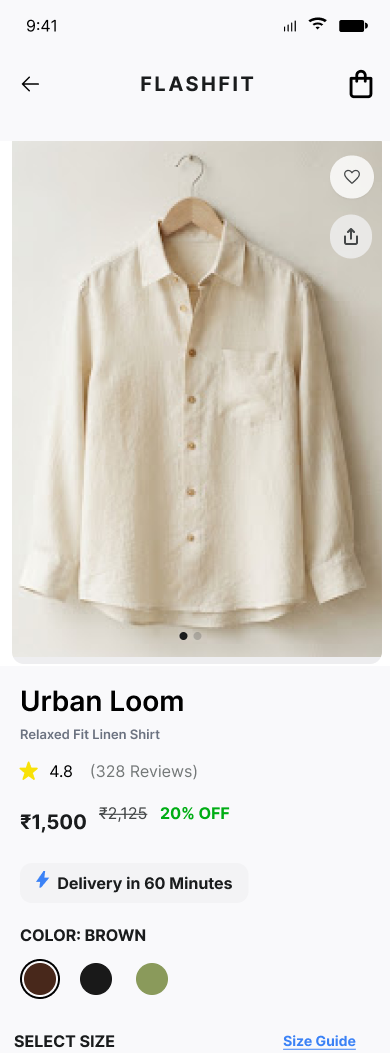
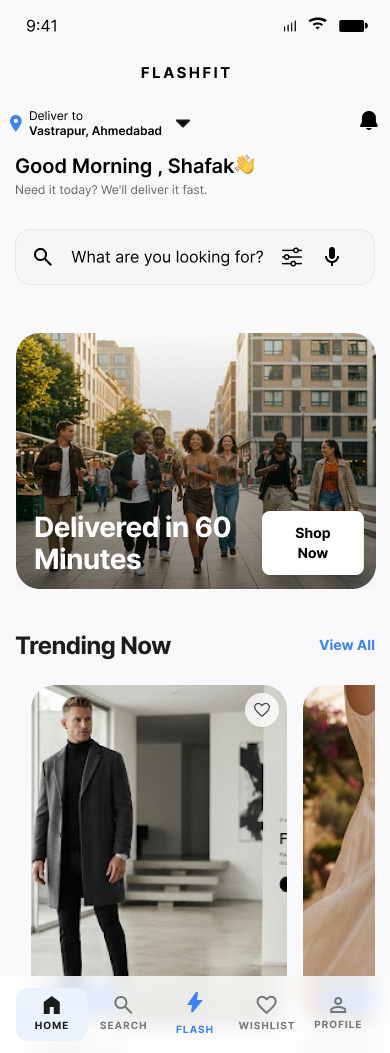

Project Overview
FlashFit is a same-day clothing delivery platform designed for last-minute outfit needs. It helps users find, try and get the right outfit quickly for social or professional events with a focus on trust, speed and fit.
Problem Statement

People frequently need clothing on short notice — for unexpected events, last-minute occasions, or sudden wardrobe needs. Traditional fashion e-commerce is designed around planned purchases with standard delivery timelines.
Identified Key Pain Points
02 · 01
Standard Timelines Fail
Slow delivery timelines don't match the immediate urgency of unexpected invitations.
02 · 02
Fit Uncertainty
No way to verify fit without trying on, amplifying the risk of buying under pressure.
02 · 03
The Trust Barrier
Traditional return processes are way too slow and tedious for urgent, time-sensitive situations.
02 · 04
Snail-Mail Returns
Traditional return processes are way too slow and tedious for urgent, time-sensitive situations.
02 · 05
Discovery Friction
Overwhelming catalogs require too much browsing effort. Discovery must be instant and occasion-focused.
User Research
Understanding urgent clothing behaviour
I conducted a mix of quantitative and qualitative research to understand how people behave when they need clothing at short notice, and what prevents them from confidently shopping online.
Research Method
Quantitative Research — Online Survey
50
Survey Responses
94.1%
of respondents said they had needed clothes urgently
100%
Avoided Online Shopping in Urgent Situations
Qualitative Research — In-depth Interviews
5
In-depth Interviews
Delivery Urgency — Users expressed frustration with standard delivery timelines that don't accommodate last-minute needs. Fit Uncertainty — Sizing concerns are amplified when there is no time to exchange — users want to get it right the first time. Trust and Familiarity — Users rely on reviews, photos, and brand familiarity to make quick decisions under pressure.
- Research focus: Urgency • Current Workarounds • Fit & Size • Delivery • Trust • Returns
Key insights
Time changes behaviour
Users expressed frustration with standard delivery timelines.
Physical stores become the fallback
When delivery feels uncertain, users prefer nearby stores.
Fit becomes a bigger risk
Receiving the wrong size is more costly when there is little time.
Trust matters under pressure
Users rely on reviews, customer photos and familiar brands.
Returns create additional anxiety
A complicated return process can make users avoid online ordering.
Key takeaway
The challenge isn't only delivering clothes faster — it's reducing uncertainty when users have less time to decide.
Affinity Map
Organizing qualitative and quantitative survey observations from our research sessions into distinct thematic clusters.
Speed / Urgency
Fit / Size
Trust
Returns
Current Workarounds
User Persona

Aarushi Mehta
Aarushi is a composite persona created from recurring patterns observed across survey responses and interviews.
“I don't need more choices. I need something that works — right now.”
About
Aarushi has a fast-paced lifestyle with a busy work schedule and an active social life. She often needs outfits for last-minute events and values convenience, speed and confidence.
Goals
- Find an outfit within 1–2 hours
- Avoid visiting multiple stores
- Feel confident before purchasing
- Find the right size quickly
Frustrations
- Delivery takes too long
- Unsure about size/fit
- Too many choices
- Doesn't trust unfamiliar products
- Returns feel like a hassle
Behaviour
- Shops on her phone
- Checks reviews and customer photos
- Browses by occasion
- Open to paying a premium for speed
User Journey
Mapping Aarushi’s end-to-end experience helped identify key moments of friction and opportunities.
| Stage | User thoughts | Pain points | Opportunities | Emotions |
|---|---|---|---|---|
| Event HappensGets an invite or last-minute plan | “What am I going to wear?” | Urgency and pressure | Occasion-based discovery | 😟 Stressed |
| SearchLooks for outfits online | “Everything takes 2–3 days.” | Delivery delays | Show same-day availability | 😕 Uncertain |
| EvaluateChecks fit, delivery, and reviews | “Will this even fit?” | Size uncertainty | Smart fit guidance | 😰 Anxious |
| PurchasePlaces order | “I hope this is the right choice.” | Trust and confidence | Real reviews and product details | 😬 Hesitant |
| Post-PurchaseTracks delivery and receives outfit | “I just hope it arrives on time.” | Anxiety about timing | Real-time tracking and support | 🙂 Relieved |
| Order DeliveredIt arrived on time… | It arrived on time. I hope it fits and works for my event. | No time for complicated returns if the outfit doesn't work. | Easy returns + clear 5-hour return window | 🙂 Satisfied & Reassured |
How Might We
How might we help people find, confidently purchase, and receive suitable clothing quickly when they have an urgent need?
Design Principles
Speed
Make finding and ordering an outfit fast and effortless
Confidence
Reduce uncertainty around fit and product choice
Build Trust
Make delivery, reviews, and returns transparent and easy.
Ideation
Translating core opportunities into verified functional solutions for the FlashFit urgency funnel.
| User Friction | Opportunity / Mechanism | Proposed Solution |
|---|---|---|
| Traditional delivery is far too slow for urgent occasion situations. | Fast Local Delivery / Local Hub Dispatch Integration | Establish direct delivery routing from urban micro-fulfillment centers and partner physical boutiques, guaranteeing same-day delivery under 1-2 hours. |
| Generic fashion catalogs force excessive search and browsing times. | Flash Urgent Mode / Curated Live-Inventory Filters | Implement a dedicated state filter showing only clothing styles physically pre-dispatched in nearby warehouses available for instant transit. |
| Users are paralyzed by size variability and fear getting wrong items. | Smart Size Recommendation / AI Body Parameter Mapping | An intelligent recommendation model combining basic body measurements with dynamic retail purchase-history fit data to calculate size with 98% accuracy. |
| Fear of missing delivery timelines creates purchase anxiety. | Social Proof Curation / Verified Community Photo Feeds | Highlighting unfiltered product images and review profiles sorted by matching user heights and weights to provide visual truth. |
| Onerous return processes introduce high personal risk. | Quick Doorstep Exchanges / Instant One-Tap Return On-Demand | Allow customers to book a priority return collection. Courier collects from their location within hours, processing refunds immediately. |
Card Sorting Analysis
To align the app's taxonomy with user expectations, cards were analyzed across target profiles. High agreement percentages in the “Urgent” cluster validated the separation of instant-delivery items from standard catalogs.
Discover
- Trending Now 92% Agreement
- New Arrivals 88% Agreement
- Brand Highlights 79% Agreement
Occasions
- Casual Fits 96%
- Party Ready 94%
- Street Style 85%
Urgent
- Flash Delivery 100%
- Express Couriers 95%
- Available Nearby 91%
Personal
- My Wishlist 94%
- Order History 91%
- Profile & Sizes 89%
Information Architecture (Sitemap)
A hierarchical overview of the FlashFit app architecture. Key emphasis is placed on the parallel conversion tracks of the standard discovery funnel and the high-speed “Flash” checkout mechanism designed for acute time constraints.
User Flow Diagrams
Primary Conversion Path (2-Hour Urgent Need)
Low-Fidelity Wireframes
Early structural exploration before visual design
Grayscale wireframe layouts focusing on urgent task flows and information hierarchy.


Design Decisions
Design choices made to handle acute time constraints and purchase anxiety.
Decision A
Why Flash Exists
Home is for discovery, Flash is dedicated urgent-shopping mode. Separating these prevents urgency from cluttering discovery.
Decision B
Why Smart Size is on Product Detail
Users need size confidence at the purchase decision point, not buried in settings.
Decision C
Why Quick Returns Matter
Urgent purchases carry more risk. Easy returns reduce perceived risk of buying under time pressure.
Decision D
Why Occasion-Based Discovery
Time-pressed users are overwhelmed by generic browsing. Occasion filtering reduces cognitive load.
Final High-Fidelity Screens
Original Hi-Fi screens are maintained on the main design page. Placeholders below indicate journey mapping.


Learnings
Key takeaways from the FlashFit project
Crucial product strategy observations formulated during the synthesis, iteration, and design of the platform ecosystem.
01
Speed Alone is Not Enough
Users need confidence in fit, trust in the product, and flexibility in returns alongside fast delivery. Solving only one dimension leaves the core anxiety unaddressed.
02
Confidence Over Convenience
When time is limited, the cost of a wrong purchase is amplified. Features that build confidence (Smart Size, reviews, customer photos) are as critical as speed in urgent fashion.
03
Research Must Drive Strategy
Every major feature in FlashFit traces back to a specific research finding. The affinity map and insight synthesis directly shaped the product roadmap and avoided feature creep.
04
Systemic Journey Design
The value of FlashFit emerges from the full experience: discover → decide → purchase → receive → evaluate. Optimizing isolated screens misses the systemic problem.